
Rooted in God’s Word

Joshua 1:7–8 reminds us that true success is found in knowing God, obeying His Word, and allowing His truth to guide every part of our lives.

Joshua 1:7–8

Joshua stood at the edge of the Promised Land with an enormous responsibility before him. Moses was dead, Israel needed a leader, and the land God had promised was still occupied by fortified cities and powerful enemies. Joshua had served faithfully beside Moses, but now the responsibility rested on his shoulders.

The Lord knew what Joshua was facing. He knew the weight of leadership, the uncertainty of what lay ahead, and the courage Joshua would need. Yet God did not begin by giving him a military plan. He directed Joshua to His Word.

“Only be strong and very courageous, that you may observe to do according to all the law which Moses My servant commanded you; do not turn from it to the right hand or to the left, that you may prosper wherever you go. This Book of the Law shall not depart from your mouth, but you shall meditate in it day and night, that you may observe to do according to all that is written in it. For then you will make your way prosperous, and then you will have good success.”

Joshua’s success would not come from his own ability. It would not depend upon the size of Israel’s army, the strength of his personality, or the wisdom of his plans. His success would come from remaining faithful to what God had spoken.

That truth still speaks to us. We may not be preparing to cross the Jordan River or lead a nation, but we also face decisions, responsibilities, fears, and seasons when we are unsure of the way forward. God’s instruction to Joshua reminds us that a steady life begins with deep roots in His Word.

Be Strong and Courageous

God told Joshua to be strong and courageous because the work before him would not be easy. Courage was necessary, but Joshua was not being told to find strength within himself. His confidence was to rest in the presence and promises of God.

Earlier in the chapter, the Lord assured Joshua that He would be with him just as He had been with Moses. God promised that He would not leave him or forsake him. Joshua could move forward because he was not going alone.

Biblical courage is not the absence of fear. It is choosing to obey God even when we feel afraid. It is taking the next step because we trust the One who has called us.

There will be times when we feel inadequate for what is before us. We may wonder whether we have enough wisdom, strength, or faith. Yet our confidence does not rest in our ability to handle every situation. It rests in the faithfulness of God. He does not always show us the entire path, but He promises to be with us as we walk it.

Observe and Obey God’s Word

The Lord told Joshua to observe and do all that was written in the Law. Joshua was not merely to read God’s Word or listen to it. He was to live according to it.

There is a difference between knowing Scripture and obeying Scripture. We can read a passage, underline a verse, and agree with what it says while still resisting the change it requires. God’s Word was never given merely to increase our knowledge. It was given to shape our lives.

James tells us, “But be doers of the word, and not hearers only, deceiving yourselves” (James 1:22, NKJV). Obedience is where truth moves from the page into the ordinary places of life. It shapes how we speak when we are frustrated, how we respond when we are hurt, how we make decisions, and how we treat the people around us.

We will never obey perfectly in this life, but a heart that loves God will increasingly desire to follow what He has said. When Scripture corrects us, we do not turn away from it. We bring our lives beneath its authority and ask the Lord to help us obey.

Do Not Turn to the Right or the Left

Joshua was told not to turn from God’s commands to the right or the left. The voices around him were not to determine his direction. God’s Word was to keep him on the path of faithfulness.

Most of us know how easy it is to miss a turn while driving because we were talking, thinking, or simply not paying attention. At first, the mistake seems small. We tell ourselves we will find another road and get back on course. A few miles later, we may discover that our little detour has taken us much farther from our destination than we intended.

Spiritual drifting often happens the same way. We rarely wake up one morning determined to wander from God. More often, we make one small compromise, ignore one clear command, or allow another voice to become louder than Scripture. Before long, we find ourselves farther from the path than we realized.

We live among many competing voices. Culture tells us what should matter. Our emotions tell us what feels right. Other people offer opinions that may sound wise and convincing. Even our own hearts can lead us away from what God has clearly spoken.

God’s Word lovingly calls us back. It remains true, steady, and trustworthy. When we begin to drift, Scripture corrects our direction. When we become confused, it gives us wisdom. When we are tempted to follow an easier path, it reminds us that faithfulness is always better than compromise.

Keep God’s Word on Your Lips

The Lord told Joshua that the Book of the Law was not to depart from his mouth. God’s truth was to shape what Joshua said because it was first shaping what he believed.

What fills our hearts eventually comes out in our words. When fear fills us, fear often speaks. When bitterness takes root, bitterness finds its way into our conversations. Yet when Scripture fills our hearts, God’s truth begins to shape how we speak and respond.

Keeping God’s Word on our lips does not mean quoting a verse in every conversation. It means allowing Scripture to influence the spirit and substance of our words. It teaches us to speak truthfully, graciously, and wisely. It gives us words to pray when we do not know what to say and reminds us how to encourage someone who is weary.

The more familiar we become with Scripture, the more readily its truth comes to mind. God’s Word gives us something stronger than our emotions to speak from.

Meditate on It Day and Night

Joshua was also told to meditate on God’s Word day and night. Biblical meditation is not the practice of emptying the mind. It is the practice of filling the mind with the truth of God and considering it carefully.

To meditate on Scripture is to slow down and think about what we have read. What does this passage reveal about God? What does it show us about the human heart? Is there a command to obey, a promise to trust, or a truth we need to remember?

Meditation allows Scripture to remain with us beyond the few moments we spend reading it. A verse may return to our thoughts while we are driving, working, making a decision, or lying awake at night. As we carry God’s Word with us, the Holy Spirit uses it to renew our minds and guide our steps.

The Lord told Joshua that obedience to His Word would lead to prosperity and good success. This was not a promise of wealth, comfort, or an easy life. Joshua would face battles, opposition, and difficult decisions. In context, success meant faithfully accomplishing the work God had given him.

Godly success is still measured differently from the success the world celebrates. It is not found merely in achievement, recognition, or comfort. It is found in knowing God, trusting His Word, and walking faithfully in what He has called us to do.

A tree does not wait until the storm arrives to begin growing roots. By then, the wind is already bending its branches and the rain is loosening the soil around it. Its ability to stand depends largely upon what has been happening beneath the surface long before the clouds gathered.

The same is true of a life rooted in God’s Word. We do not wait until hardship comes to begin learning who God is and what He has promised. Day by day, Scripture sends its roots deeper into our hearts. Then, when life becomes uncertain, we have something stronger than our emotions to hold us steady.

A life rooted in Scripture will not be a life without storms. It will be a life with a foundation strong enough to stand through them. God’s Word gives courage when we are afraid, wisdom when we are uncertain, correction when we begin to wander, and hope when the way ahead feels difficult.

We do not become rooted in God’s Word through an occasional glance. Roots grow as we return to Scripture day after day, asking the Lord to teach us, correct us, and lead us. As His truth settles deeply within us, it begins to shape the way we think, speak, respond, and live.

True success begins here, not with confidence in ourselves, but with a life anchored in the Word of God.

Why Seven More Days?

After Noah entered the ark, God waited seven more days before sending the flood. Those quiet days remind us that God is patient and merciful, but His warnings should never be ignored.

“For after seven more days I will cause it to rain on the earth forty days and forty nights.”
Genesis 7:4, NKJV

Have you ever wondered why, after Noah, his family, and the animals entered the ark, God waited seven more days before sending the flood?

Scripture does not tell us exactly why God chose to wait. We should be careful not to claim more than the text reveals. What Genesis does tell us is that the ark had been completed, Noah had obeyed the Lord, his family had entered, and the animals had come to him as God commanded. Everything was ready, yet the rain did not begin immediately.

God said to Noah, “For after seven more days I will cause it to rain on the earth” (Genesis 7:4). Genesis 7:10 confirms that “after seven days the waters of the flood were on the earth.” Between the warning and the first drops of rain stood seven quiet days.

We can only imagine what others may have thought as the ark stood before them. Noah had spent years building something that must have appeared unnecessary and unreasonable to those around him. Then the animals came and entered the ark. Noah and his family went inside, but the skies remained unchanged. Day followed day, and still there was no rain.

Jesus described the people of Noah’s generation as “eating and drinking, marrying and giving in marriage, until the day that Noah entered the ark” (Matthew 24:38). These ordinary activities were not wrong in themselves. The problem was that the people continued living as though God had never spoken. They went on with their plans while ignoring the warning standing plainly before them.

The ark was not hidden. Noah’s obedience was visible. God’s warning had been given, and the coming judgment had been announced. Yet life continued as usual.

Those seven days reveal something important about the character of God. Judgment did not come without warning. God had already declared that human wickedness was great and that “every intent of the thoughts of his heart was only evil continually” (Genesis 6:5). The earth was corrupt and filled with violence, but God remained patient while Noah prepared the ark.

Peter later wrote that “the Divine longsuffering waited in the days of Noah, while the ark was being prepared” (1 Peter 3:20). Every day the ark was under construction was another day in which judgment had not yet fallen. Every blow of Noah’s hammer bore witness to what God had said. God’s patience was not weakness, and His silence did not mean He had changed His mind. He was giving time before judgment came.

Then came seven more days.

Seven more days in which the ark remained visible. Seven more days in which the warning could be considered. Seven more days in which the patience of God continued.

Then Genesis records one of the most sobering sentences in the account.

“And the LORD shut him in” (Genesis 7:16).

Noah did not close the door. The Lord did. The same God who had warned the people, waited patiently, and provided a place of safety was also the God who finally shut the door.

Once that door was closed, the opportunity to enter had ended. When the rain began and the waters rose, the ark was no longer something to question or dismiss. It became the only place of safety from the judgment God had promised.

The account of Noah is not only about something that happened long ago. Jesus pointed back to the days of Noah when teaching about His own return. He warned that people would again be occupied with daily life and unaware of how near judgment was until it came upon them (Matthew 24:37–39).

God is still patient. He still calls sinners to repentance, and He has provided a place of refuge through His Son. Jesus said, “I am the door. If anyone enters by Me, he will be saved” (John 10:9). Salvation is not found through our goodness, our efforts, or our intention to do better someday. It is found in Christ alone.

The door of salvation is open today. Jesus receives all who come to Him in repentance and faith. His death on the cross satisfied the judgment our sin deserved, and His resurrection assures us that His saving work is complete. We do not have to clean ourselves up before coming to Him. We come because we cannot save ourselves.

Yet the days of Noah remind us that God’s patience should never be mistaken for permission to delay. Peter wrote that the Lord is “not willing that any should perish but that all should come to repentance” (2 Peter 3:9). His patience is mercy, but His patience has a purpose. It gives us time to respond to His call.

Perhaps there is someone who has heard the gospel many times but continues to put off coming to Christ. Perhaps there is a believer who has grown comfortable ignoring an area in which God has been calling them to obedience. The lesson of those seven days is not that there will always be more time. The lesson is that while God is patient, we should respond when He speaks.

The people of Noah’s day could see the ark, but seeing it was not enough. They could hear the warning, but hearing it was not enough. Safety was found only inside the refuge God had provided.

The same is true today. It is not enough to know about Jesus, admire His teaching, or agree that the gospel is true. We must come to Him and place our trust in Him.

God waited seven more days. Then the rain began, and the Lord shut the door.

Truth to Carry

God’s patience is an expression of His mercy, but His mercy should never be mistaken for the absence of coming judgment. Today, the door of salvation remains open through Jesus Christ.

Does Romans 12:2 Teach Neuroplasticity?

Romans 12:2 speaks of the renewing of the mind, but is Paul describing neuroplasticity, or a deeper spiritual transformation through God’s truth?

“And do not be conformed to this world, but be transformed by the renewing of your mind, that you may prove what is that good and acceptable and perfect will of God.”
Romans 12:2 (NKJV)

Neuroplasticity has become an increasingly popular topic in recent years. Articles, podcasts, books, and social media posts often connect it with Romans 12:2, suggesting that Paul was describing the brain’s ability to “rewire” itself long before modern neuroscience discovered it. It is certainly an interesting comparison, but before we accept or reject the idea, we should ask a more important question. Is that what Paul was actually teaching?

Whenever we approach Scripture, our first responsibility is not to ask what a passage could mean to us today. We must first understand what the Holy Spirit intended through the biblical author. Only then can we faithfully apply it to our lives.

Beginning with the Context

Romans 12 does not stand alone. It begins with the word therefore, connecting it to everything Paul has written in the previous eleven chapters. Those chapters unfold the gospel from beginning to end. Paul explains humanity’s sin, God’s righteousness, justification by faith, our union with Christ, the work of the Holy Spirit, God’s sovereign purposes, and His abundant mercy toward those who believe.

Only after laying that foundation does Paul begin speaking about the believer’s daily life. He writes, “I beseech you therefore, brethren, by the mercies of God, that you present your bodies a living sacrifice” (Romans 12:1). Then he continues, “And do not be conformed to this world, but be transformed by the renewing of your mind” (Romans 12:2).

The order matters. Transformation is never presented as the means of earning God’s favor. It is the response of those who have already received His mercy. The Christian life always begins with what God has done before it speaks about what we are called to do.

What Does Paul Mean?

Several key words help us understand the verse. The word conformed means to be shaped or molded according to a pattern. Paul warns believers not to allow the world’s values, priorities, and way of thinking to become the pattern for their lives.

The word transformed comes from the Greek word metamorphoō. It describes an inward change that becomes visible outwardly. It is the same word used of Christ’s transfiguration in Matthew 17:2. Paul is describing something much deeper than improved behavior. He is speaking about an inner transformation that God produces.

Then Paul speaks of “the renewing of your mind.” The Greek word nous refers to the mind as the center of understanding, thinking, moral judgment, and spiritual perception. Paul is not talking about intellectual ability alone. He is describing the whole way a believer learns to think according to God’s truth.

This transformation is part of God’s ongoing work of sanctification. Through the Holy Spirit and the Word of God, believers gradually learn to view life from God’s perspective rather than the world’s. That is Paul’s concern. He is teaching spiritual transformation.

What Is Neuroplasticity?

Neuroplasticity is a scientific term describing the brain’s remarkable ability to adapt and change. For many years, scientists believed the adult brain was relatively fixed. Research has shown otherwise. Throughout life, the brain can form new neural connections, strengthen existing pathways, and weaken others through repeated learning, practice, habits, and experiences.

Someone learning a musical instrument develops new patterns in the brain. A person recovering from a stroke may regain certain abilities because other parts of the brain adapt. Even repeated thought patterns can influence how neural pathways develop over time.

These observations are part of neuroscience. They describe something measurable within the physical brain. As Christians, we should not be surprised by this. The God who created the human body also created the human brain. Discovering how His creation functions should increase our appreciation for His wisdom, not diminish it.

Science helps us understand many aspects of God’s creation, but it asks different questions than Scripture.

Where Confusion Begins

Problems arise when scientific observations are confused with biblical interpretation. Some Christian teachers suggest Romans 12:2 is actually describing neuroplasticity. Others imply that Paul somehow anticipated modern neuroscience. That gives the verse a meaning Paul never intended.

Paul was not writing about neurons, synapses, or brain chemistry. He was writing to believers living in Rome, urging them to think differently because they belonged to Christ. His concern was spiritual.

The renewed mind of Romans 12:2 is not primarily about the physical brain. It is about the inner life of the believer being continually shaped by God’s truth. That distinction matters. Scripture should never be interpreted through the lens of modern scientific discoveries. Instead, science should be understood within the larger framework of God’s revealed truth.

Can the Two Be Related?

Yes, but they should not be confused.

Suppose a believer spends years reading Scripture, praying, worshiping, memorizing God’s Word, and learning to respond to life with biblical wisdom rather than fear or anger. Neuroscience may observe measurable changes within that person’s brain. Romans 12:2 explains something even greater. God is transforming His child.

Science may describe physical changes that accompany spiritual growth, but it cannot explain the source of that transformation. The Holy Spirit is not another name for neuroplasticity, and neuroplasticity is not another way of describing sanctification.

One belongs to neuroscience, while the other belongs to biblical theology. They may intersect because God created both the physical and spiritual aspects of humanity, but they are not identical.

The Renewing of the Mind

The Bible consistently connects transformation with God’s Word. Jesus prayed, “Sanctify them by Your truth. Your word is truth” (John 17:17). Paul reminded Timothy, “All Scripture is given by inspiration of God” and is able to make the man of God “complete, thoroughly equipped for every good work” (2 Timothy 3:16–17). The psalmist wrote, “Your word I have hidden in my heart, that I might not sin against You” (Psalm 119:11).

The pattern is clear. God uses His truth to change His people. That change affects how we think, what we love, the decisions we make, and the way we respond to life’s circumstances. Our minds are renewed as God’s truth continually corrects our thinking.

Why This Matters

The world constantly offers competing messages about identity, purpose, success, and truth. Every day we are encouraged to define ourselves by our feelings, our achievements, our failures, or the opinions of others.

Romans 12:2 calls believers to a different way of thinking. Our identity is not determined by culture. It is found in Christ. Our purpose is not discovered simply by looking inward. It is revealed by the God who created us. Our hope is not rooted in positive thinking. It rests in the finished work of Jesus Christ.

As our minds are shaped by Scripture, our lives begin to reflect the character of Christ. That transformation often happens quietly and gradually. Sometimes we notice it only after looking back over many months or years. Yet God is faithfully at work.

A Balanced Perspective

Christians do not need to fear legitimate scientific discoveries. If neuroscience helps explain how repeated learning affects the brain, we can appreciate that as part of God’s design. At the same time, we should resist the temptation to make Scripture say more than it actually says.

Romans 12:2 is not a lesson on brain science. It is a call to spiritual transformation through the renewing work of God. Science may describe what happens within the brain. Scripture reveals what God is doing within the believer. These are not necessarily competing explanations, but they answer different questions.

Truth to Carry

Romans 12:2 does not teach neuroplasticity. It teaches something even greater. God does not simply improve our behavior. He transforms our lives. Through His Spirit, His Word, and His abundant mercy, He renews the minds of those who belong to Him. As our thinking is shaped by His truth, our lives increasingly reflect the One who has redeemed us.

Science may continue to uncover remarkable truths about the human brain, and we can receive those discoveries with gratitude. But our confidence has never rested in neural pathways or scientific explanations. It rests in the God who created us, redeemed us through His Son, and continues His faithful work of making us more like Christ.

Right Ear, Right Thumb, and Right Toe

Why did Moses place blood on the right ear, right thumb, and right big toe of both the priests and the cleansed leper? This repeated detail in Leviticus is easy to overlook, yet it points to a beautiful truth about what it means to belong to God. Sometimes the smallest details in Scripture help us see the biggest truths.

When we read the Old Testament, we often discover that the Lord teaches us through details we might otherwise overlook. Leviticus, in particular, invites us to slow down and pay attention. What may seem unusual at first often helps us understand something important about God and His work among His people.

One such detail appears twice. The first time is when Aaron and his sons are set apart for the priesthood (Leviticus 8:23–24). The second is when a leper is cleansed and restored to the community (Leviticus 14:14). In both cases, blood is placed on the right ear, the right thumb, and the right big toe.

Leviticus does not explain why these particular parts of the body were marked, but the repeated pattern invites us to consider its significance. The ear reminds us of listening to God’s voice. Before we speak, before we act, we are to hear His voice. The thumb reminds us that our work, whatever it may be, belongs to Him. The toe reminds us that our walk is to follow where He leads us.

Whether it was the priest being set apart for service or the leper being restored after cleansing, the picture is the same. God was claiming the whole life as His own.

The same truth carries into our life in Christ. His blood does not mark our bodies as it did under the old covenant, but those He redeems are set apart for Him. He calls us to listen to His Word, serve Him faithfully, and follow where He leads.

Truth to Carry

The life redeemed by Christ is a life set apart for Christ: ears to hear Him, hands to serve Him, and feet to follow Him.

Resurrection Power

Scripture records several people being raised from the dead, but each one eventually died again. Jesus rose never to die again, and through Him, those who are spiritually dead are made alive and given eternal life.

Throughout Scripture, we see that God alone has the power to give life where death has taken hold. Elijah prayed over the widow’s son at Zarephath, and God restored his life. Elisha called upon the Lord, and the Shunammite woman’s son was raised. Years later, a dead man came back to life when his body touched the bones of Elisha. These were very different circumstances, but in each one, the power belonged to God.

The same is true in the New Testament. Jesus raised Jairus’s daughter, the widow’s son at Nain, and Lazarus. God restored Tabitha through Peter and Eutychus through Paul. The people were different, and the circumstances were different, but the source of life was always the same. Elijah did not possess resurrection power. Neither did Elisha, Peter, or Paul. They were servants through whom God chose to work.

Jesus, however, is unlike any of them. He did not simply raise the dead. He said, “I am the resurrection and the life” (John 11:25, NKJV). Life does not merely come through Him. Life is found in Him.

There is something important to notice about every person raised in these accounts. They all eventually died again. Lazarus died again. Jairus’s daughter died again. The widow’s son at Nain died again. Their return to life was real and miraculous, but it was temporary. Death had been delayed, not defeated.

The resurrection of Jesus was different. He rose from the grave never to die again. Scripture says, “Christ, having been raised from the dead, dies no more. Death no longer has dominion over Him” (Romans 6:9, NKJV). Jesus did not simply return to earthly life. He conquered death.

Scripture also tells us that apart from Christ, we are spiritually dead in our trespasses and sins. We cannot give ourselves spiritual life any more than Lazarus could call himself out of the tomb. Yet God, in His mercy, makes us alive in Christ.

“And you He made alive, who were dead in trespasses and sins.”

Ephesians 2:1 (NKJV)

Those raised physically in Scripture received their earthly lives back for a time. Those who are made alive in Christ receive eternal life. The same God who raised the widow’s son, Jairus’s daughter, and Lazarus is the God who gives new life to those who come to Christ.

Truth to Carry

Unless Christ returns first, each of us will face physical death. But for those who belong to Him, death is not the end. We have been made alive in Christ, and we will live with Him forever. The One who conquered death holds our future securely in His hands.

Before We Share a Verse…

Before sharing a Bible verse, it is worth pausing to ask what it actually says and what it means in context.

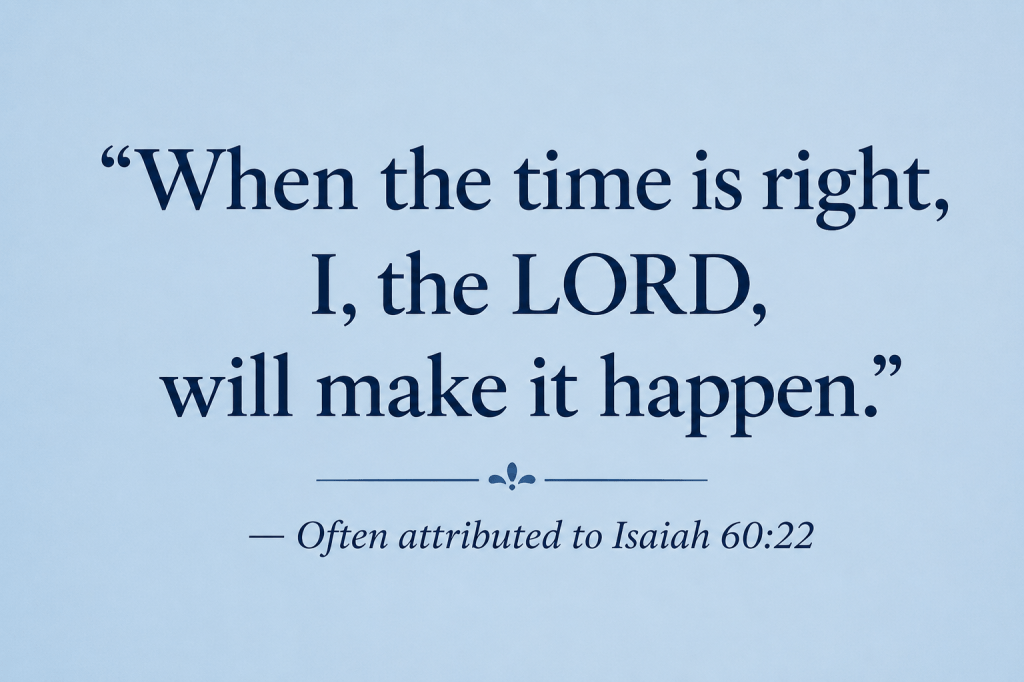
Social media is filled with encouraging Bible verses and inspirational quotes, many of them shared with sincere intentions. Yet a search for Isaiah 60:22 brings up image after image with these words:

“When the time is right, I, the LORD, will make it happen.”

The words sound biblical, but before we click Share, there are two questions every believer should learn to ask: Is this what the verse actually says? And just as importantly, is this what the verse actually means?

When we open our Bible, we find that Isaiah 60:22 reads:

“A little one shall become a thousand,
And a small one a strong nation.
I, the LORD, will hasten it in its time.”

The popular quote is a shortened paraphrase of the final phrase. It leaves out the first part of the verse and separates the words from their original setting. Isaiah 60 is a prophecy concerning the future restoration and glory of Zion. God is declaring that what appears small will become great because He will accomplish His purposes at the appointed time.

Trusting God’s timing is certainly biblical. The concern is not with encouraging someone to wait on the Lord. The concern is presenting a paraphrase as though it were the actual wording of Scripture, then applying it without considering what the passage is saying.

The Bereans were commended because they received the message willingly while also examining it in the light of God’s Word:

“These were more fair-minded than those in Thessalonica, in that they received the word with all readiness, and searched the Scriptures daily to find out whether these things were so.” Acts 17:11 (NKJV)

Discernment is not about finding fault with everyone who creates or shares an encouraging post. Most people are simply trying to offer hope. It is about loving God’s Word enough to handle it carefully and taking the time to understand what He has actually said.

Before sharing a verse, it helps to ask:

• Does the Bible actually say this?
• What is the surrounding context?
• Who is speaking, and who is being addressed?
• What is God teaching through this passage?

These questions do not weaken our faith or take away from the encouragement. They help root our faith in God’s Word rather than in words that merely sound biblical.

For someone who is waiting on the Lord, Psalm 27 gives us a passage that speaks beautifully and honestly:

“I would have lost heart, unless I had believed
That I would see the goodness of the LORD
In the land of the living.
Wait on the LORD;
Be of good courage,
And He shall strengthen your heart;
Wait, I say, on the LORD!” Psalm 27:13–14 (NKJV)

David does not promise that every difficult circumstance will immediately change. He points us to the Lord, who strengthens the hearts of those who wait upon Him.

Truth to Carry:

Biblical discernment does not lessen our encouragement. It gives it a firm foundation. Before we share a verse, let’s open our Bible, read the passage, and make sure the words we are sharing are truly what God has said.

It Is Finished!

When Jesus declared, “It is finished,” He announced that the work of redemption had been fully accomplished.

So much of life teaches us to begin with ourselves. What must I do to be accepted? What must I do to be forgiven? What must I do to make myself right with God?

The gospel begins somewhere else. It begins with what God has done for us through Jesus Christ.

The Son of God took on flesh and dwelt among us (John 1:14). He lived in this world and faced temptation, yet He remained without sin (Hebrews 4:15). He fulfilled the Law we had broken (Matthew 5:17), bore our sins in His own body on the tree (1 Peter 2:24), and took the punishment our sin deserved.

As Jesus hung on the cross, He said, “It is finished!” (John 19:30, NKJV). The work required for our redemption had been completed. Nothing was left for us to add, and nothing we could ever do would improve upon what Christ had already accomplished.

The cross was not the end. On the third day, Jesus rose from the dead, just as the Scriptures had said (1 Corinthians 15:3–4). He is alive, He intercedes for His people before the Father (Hebrews 7:25), and one day He will return and receive His own to Himself (John 14:3).

Salvation is not something we earn by being good enough or working hard enough. It is given by grace and received through faith, “not of works, lest anyone should boast” (Ephesians 2:8–9, NKJV).

We do not make our way to God by our own effort. God came to us in Jesus Christ and did for us what we could never do for ourselves.

Truth to Carry

Our hope rests in what Christ has already done for us, not in what we can do for Him.

The Fragrance of Devotion

Mary’s costly gift filled the room with fragrance, but her act of devotion reached far beyond that moment. She poured out what was precious because she understood something others had not yet seen about Jesus.

John 12:1-8; Mark 14:3-9

Mary did not come to Jesus empty-handed that evening. She came with intention. John tells us that a supper was made for Jesus in Bethany. Martha was serving, Lazarus was at the table, and Jesus was there among them (John 12:1-2). Lazarus, who had once been in the tomb, was now alive by the mercy and power of Christ. Martha served, as we have seen her do before. And Mary came again to the feet of Jesus.

This moment was not born in a rush. It was born out of relationship. Mary had been at Jesus’ feet before, listening to His words and receiving what He taught (Luke 10:39). She had fallen at His feet in grief after Lazarus died (John 11:32). Now she came to His feet in worship. Passover was drawing near, and the cross was only days away. Mary may not have understood the fullness of what was coming, but her love for Jesus moved her to bring what was precious.

John tells us she brought “a pound of very costly oil of spikenard” and anointed the feet of Jesus (John 12:3 NKJV). Mark tells us she broke the alabaster flask and poured the oil on His head (Mark 14:3). Mary’s gift was not something that cost her little. The oil was worth about three hundred denarii, close to a year’s wages (John 12:5). This was not a casual gift. It was costly, sacrificial, and deeply personal.

Once the perfume was poured out, there was no gathering it back. John says, “And the house was filled with the fragrance of the oil” (John 12:3 NKJV). Everyone in the room was touched by the fragrance of what Mary gave to Jesus. Her worship could not be hidden. It filled the house.

Then Mary did something even more humbling. She wiped His feet with her hair. In that culture, for a woman to let down her hair in public would have been viewed as improper or shameful. Yet Mary seemed far more concerned with honoring Jesus than with how she might be seen by others. She came low before Him, not trying to protect her dignity, but pouring out her love.

Judas saw the same moment and called it waste. “Why was this fragrant oil not sold for three hundred denarii and given to the poor?” (John 12:5 NKJV). On the surface, his words sounded practical, even compassionate. But John tells us the truth: Judas did not care for the poor. He was a thief, and as keeper of the money box, he used to take what was put in it (John 12:6).

What Mary poured out in love, Judas measured in profit.

But Jesus saw her gift for what it was. He said, “Let her alone; she has kept this for the day of My burial” (John 12:7 NKJV). Mark records His words this way: “She has come beforehand to anoint My body for burial” (Mark 14:8 NKJV).

Those words should have stopped everyone in the room. Burial. Jesus was speaking of His death, yet Scripture does not record anyone asking what He meant. It is as if the word passed by unnoticed. They were still thinking about the cost of the perfume, while Jesus was speaking of the cost of the cross.

Mary’s act of devotion pointed ahead to His burial. Whether she understood all of it or not, Jesus did. The head she anointed would soon wear a crown of thorns. The feet she touched would soon be nailed to the cross. The body she honored would soon be laid in a tomb.

After the Sabbath, women would come to the tomb with spices to anoint the body of Jesus, but they would never have the chance. When they arrived, the stone had been rolled away, and Jesus had risen (Mark 16:1-6). They came prepared to honor Him in death, but death could not hold Him. Mary’s act in Bethany had already become an anointing before His burial.

Jesus said, “Wherever this gospel is preached in the whole world, what this woman has done will also be told as a memorial to her” (Mark 14:9 NKJV). Mary did not worship so she would be remembered. She worshiped because Jesus was worthy. Yet here we are, still telling the story.

Sometimes devotion to Jesus will be misunderstood. Sometimes obedience will look foolish to people who do not understand your love for Him. But Jesus sees what is offered from a heart of love. He receives what is poured out before Him in faith.

Mary gave what was costly because Jesus was worthy. And when we remember the cross and the empty tomb, how can we not offer Him our whole hearts?

Truth to Carry

What is poured out in love for Jesus is never wasted. He is worthy of our worship, our devotion, and our whole heart.

Can a Minute in God’s Word Make a Difference?

Have you ever opened your Bible and wondered whether a few minutes in God’s Word could really make a difference?

That is the purpose behind A Minute in the Word. These short reflections are meant to help us pause, look carefully at Scripture, and carry one truth with us into the day. A single minute may seem small, but God can use one passage, one verse, or one quiet moment to speak to the heart.

A seed does not become a tree overnight. It takes root and grows little by little, often before anything can be seen above the ground. God frequently works in us through His Word in much the same way. We may not immediately recognize what He is doing, but every time we return to Scripture, His truth is being planted more deeply within us.

So keep reading. Keep listening. Keep spending time with Him. A minute in God’s Word may seem brief, but God may be doing far more in your heart than you can see.

Breathe of God

God formed Adam from the dust of the ground, but it was not until He breathed into him that Adam became a living being. The breath of God reminds us that life is not something we create for ourselves. It is a gift that comes from the One who made us.

Have you ever noticed that when God created Adam, He did something Scripture does not say He did with any other living creature?

God formed Adam from the dust of the ground and then “breathed into his nostrils the breath of life” (Genesis 2:7).

The Hebrew phrase used here is nishmat chayyim—”the breath of life.” It is a beautiful picture of God’s personal involvement in the creation of man.

Animals were certainly alive and are described as having the “breath of life” (Genesis 6:17; 7:15). Yet Scripture never describes God personally breathing into the animals, birds, fish, or other creatures as He did Adam. In Genesis 6:17 and 7:15, a different Hebrew phrase is used, ruach chayyim, meaning “the breath” or “spirit of life.”

Many theologians see this distinction as emphasizing humanity’s unique relationship with God. Human beings are not merely living creatures. We are created in God’s image (Genesis 1:26-27). The divine breath highlights that special status.

Perhaps this helps answer the psalmist’s question:

“What is man that You are mindful of him, and the son of man that You visit him?” (Psalm 8:4)

Of all God’s creation, humanity alone is described as being made in His image and personally receiving the breath of life. From the moment God breathed into Adam’s nostrils, mankind was created for fellowship with Him.

The God who breathed physical life into Adam is the same God who gives spiritual life through Jesus Christ. What began with God’s breath in Genesis points us to the One who said, “I have come that they may have life, and that they may have it more abundantly” (John 10:10).

Truth to Carry

The God who breathed life into Adam still gives life today. You were created in His image, formed for fellowship with Him, and invited to find life in Christ